
ONLINE CEU COURSE
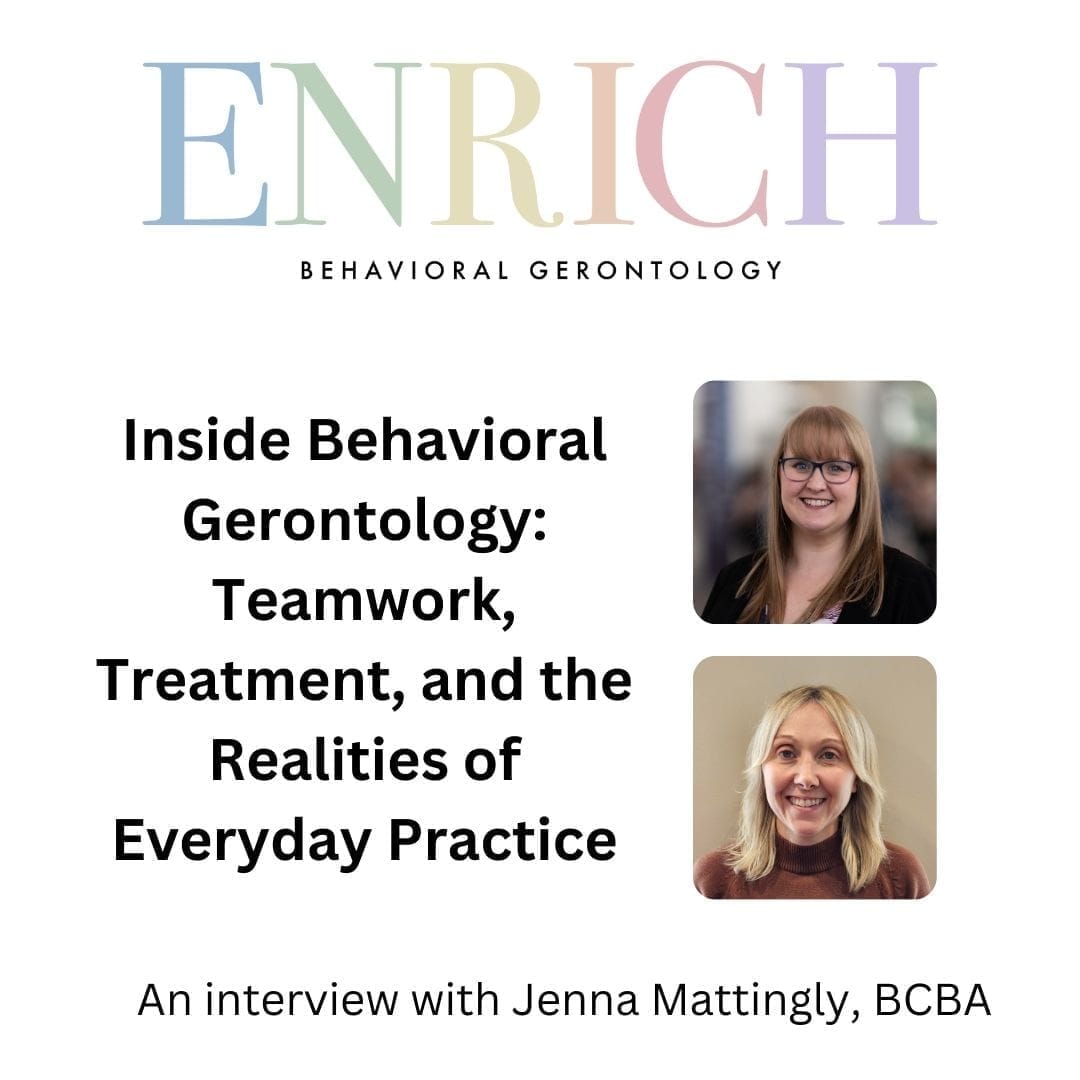
Inside Behavioral Gerontology: Teamwork, Treatment, and the Realities of Everyday Practice
Explore the day-to-day practice of behavioral gerontologist Jenna Mattingly as she chats with Dr Zoe Lucock all about her role in a 300-bed care facility, gives examples of real life behavioral gerontology practice, discusses how she balances a behavioural approach with a pharmacological approach, tips for working successfully in an interdisciplinary team, and the challenges of staff training.
This interview is a must-watch for BCBAs, behavior analysts in aging services, students, and anyone interested in applying behavioral science in gerontology. You’ll gain practical strategies, fresh perspectives, and a deeper appreciation for the complexity, and the profound impact, of this work.

Unique look into the role
Learn what the day to day life of a behavioral gerontologist looks like and hear real life examples of day to day practice.

Complete at your own pace.
Everything is completed online in short videos to keep your attention and break up learning.

Earn CEUs
As an ACE provider, this course from Enrich Behavioral Gerontology will provide you with 1 BACB Learning CEU.
About the course
In this exclusive recorded discussion, Zoe sits down with Jenna Mattingly, a Board Certified Behavior Analyst and behavioral gerontologist based in Minnesota, whose career has been dedicated to supporting older adults in skilled nursing care. Although their professional paths have crossed for years, a recent CEU interaction finally brought them together, leading to this in-depth, practical, and inspiring conversation about what behavioral gerontology really looks like day to day.
A Realistic Look at the Role
Jenna shares what it means to work as a Licensed Behavior Analyst in a 300-bed skilled nursing facility—one of three Behavior Analysts supporting residents with neurocognitive disorders, mental health diagnoses, and complex care needs. She walks through her daily routine, from reviewing nursing reports to observing care tasks, documenting interactions, presenting behavior data in interdisciplinary meetings, and supporting nursing staff across shifts.
Case Examples You Can Learn From
Jenna presents both simple and complex interventions, showing how small, compassionate changes can make a big difference:
A “combative” resident whose distress vanished when staff slowed the transfer process and provided physical reassurance.
A case where hallucinations, aggression, and delusions turned out to be symptoms of a UTI and pain, requiring close interdisciplinary coordination.
Interdisciplinary Collaboration
Jenna offers practical advice for thriving in an interdisciplinary team environment:
communicating in clinical language that makes sense to nursing and therapy teams,
being humble and learning from other professionals,
avoiding the “BCBA who wants to control everything,” and
designing interventions that are simple, low-effort, and easy for nursing staff to implement.
Translating Behavioral Concepts Into Everyday Language
You’ll hear how Jenna reframes behavioral principles—such as conditioned aversives or SDs—in ways that resonate with nursing teams and direct care staff, focusing on relationship-building and increasing positive interactions.
Navigating Medication vs. Behavioral Intervention
Jenna speaks candidly about the challenges of balancing behavioral recommendations with the medical team’s desire for fast solutions. She shares insights on:
advocating for non-pharmacological supports,
monitoring side effects (including those often overlooked), and
collaborating with prescribers during medication tapering.
The Real Challenges: Staff Training & Turnover
From limited access to night-shift staff, to language barriers, to the lack of consistent systems for training and accountability, Jenna offers a transparent look at the realities of supporting caregivers in a 24-hour facility, and the creative ways she works to bridge those gaps.
What others are saying...

Mandy
"This was excellent! As an independent support worker I find myself in a similar position, in terms of needing to work alongside teams from Health and social care. Some of the perspectives shared here were very useful. I also very much enjoyed the practical examples and the outline of what can help or hinder a person’s experience of being supported."


Shawna
I appreciated the balanced message that effective outcomes are the result of true collaboration, not the sole responsibility of any one discipline. This framing felt realistic, ethical, and supportive of sustainable practice, particularly in complex geriatric cases where medical, psychosocial, environmental, and behavioural factors intersect. Overall, this course strengthened my appreciation for interdisciplinary teamwork and clarified my role within it in a way that will directly inform my clinical practice."

Reviews
Coming soon
About your Interviewer
Dr. Zoe Lucock is a behavioral gerontologist dedicated to integrating behavior-analytic services into mainstream older adult care. With a passion for enriching the lives of older adults, she has published research in journals such as the Journal of Applied Behavior Analysis and Behavior Analysis in Practice.
As Chair of the ABAI Behavioral Gerontology Special Interest Group, Dr. Lucock has led the development of webinars and resources to expand the field’s reach. She is also a frequent speaker at conferences such as ABAI and EABG, presenting on dementia, learning disabilities and dementia, and ethical issues in behavioral gerontology.
With a Ph.D. in behavioral gerontology and experience founding the UK’s first behavioral gerontology service provision, Dr. Lucock brings a wealth of research and clinical expertise. She is also a fellow of the Higher Education Academy showing excellence in teaching in higher education and has taught students in behavior analysis at both undergraduate and postgraduate level.
Her passion project, Enrich Behavioral Gerontology, allows her to share this knowledge with others who want to make a difference in the lives of older adults.

Buy the Course
Got questions?
BCBAs/BCaBAs/RBTs/UKBA(Cert)s who work with or have an interest in working with older adults.
You have 90 days from purchasing the course to complete it. This is a limited hold schedule to ensure you complete it!
Yes! Enrich Behavioral Gerontology is a BACB authorised ACE provider, and this course is worth 1 BCBA learning CEU.
When you have completed the course, you will receive an email with your certificate attached. Remember to enter your BACB ID number when you sign up!
These CEUs are also suitable for renewing your UKSBA membership.
I estimate that the course will take roughly one hour and 15mins to complete from start to finish including completing the quizzes to test your understanding.
Definitely! You don't need to be certified to want to learn more about ABA with older adults. Many masters degrees in ABA don't have any content about this niche area, so seeking out additional learning beyond the course curriculum is a great way to develop your skills as a behavior analyst.
Absolutely! This course is available to anyone in the world and I don't think it would be right to restrict access. The content is suitable for Behavior Analysts interested in working with people with dementia no matter where you live and work. I try to use American spellings wherever possible but as a British Behavior Analysts, I do sometimes forget and slip into British English spellings :)
All courses are paid for via PayPal, credit card (Stripe), or Apple Pay so you have peace of mind that your details are protected.
There are no prerequisites for this course.